mercoledì 23 gennaio 2013

Mostra FIRENZE ROMANA

Da sabato 26 gennaio (giorno dell'inaugurazione) a sabato 2 febbraio allo spazio eventi del Centro Commerciale di Ponte a Greve sarà allestista la "Firenze Romana", mostra descrittiva e fotografica curata dal Gruppo Archeologico Fiorentino in collaborazione con la Sezione Soci Firenze Sud-Ovest e il Centro Commerciale stesso, con un particolare riferimento all'area di San Lorenzo a Greve. L'evento, che segue un precedente del 2004 della Soprintedenza per i Beni Archeologici per la Toscana, pone l'accento sulla storia della colonia romana e ricostruisce lo sviluppo della città fino agli inizi del Medioevo. Nelle vetrine saranno anche esposti riproduzioni di oggetti usati all'epoca, ricostruzioni di scene e fotografie originali e in 3D. 
Orario: lun.-ven. 15-30-18.30; sab. e dom. 10-12 e 15.30-18.30.

martedì 25 settembre 2012

Mostra Firenze delle Torri


Dal 29 settembre al 7 ottobre sarà allestita alla Limoniaia di Villa Vogel la mostra "Firenze delle Torri", ideata e curata dal Gruppo Archeologico Fiorentino, un'associazione onlus del DopoLavoro Ferroviario.
L'esposizione, costituita da 32 grandi pannelli descrittivi e fotografici, analizza e ricostruisce le torri della città medievale, nate per scopi difensivi, ma diventate anche simbolo del potere della famiglia a cui appartenevano.

L'evento, ad ingresso gratuito, avrà il seguente orario: tutti i giorni dalle 15 alle 18, sabato e domenica anche dalle 10 alle 12.

martedì 12 giugno 2012

THE ETRUSCAN LANGUAGE RIDDLE


By  Enio Pecchioni

Scholars can not yet entirely translate the language spoken in Etruria in historic times. The innumerable attempts made by the greatest masters in linguistics and philology have failed to decipher a language which was spoken in Tuscany up the beginning of the Christian era and which the Etruscan priests must have used both in Tuscany and in Rome itself up to the end of th 5th century A.D.
In othe fields, there has been no lack of discoveries which have permitted us to understand idioms seemingly even more difficult to tackle than Etruscan. Some years ago, the Hittite pictographic language was deciphered and, quite recently, the language spoken by the Mycenaeans, known as Linear B, as well. In all cases the difficulties were duly overcome and the solution of the problems has opened up a magnificent field to linguistic research. The wide interest rightly aroused by the deciphering of Mycenaean at once springs to mind; since from it we learn that at Mycenae and in Crete the language spoken in the second millenium B.C. was very close to Homeric Greek.
Also the Etruscans used a language near to Greek, and with a Greek alphabet, but this language was not Indo-European and probably connected with certain pre-Hellenic languages of eastern Mediterranean. A related language was still used on Lemnos in the archaic period, as the inscription on the stele of Caminia proves.

martedì 5 giugno 2012

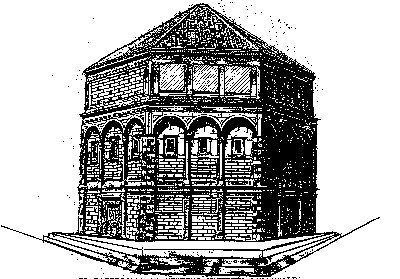
Il Battistero di San Giovanni


La crisi economica e demografica che afflisse l’Italia dalla metà del IV al VI secolo d.C., non aveva impedito, grazie a Teodorico, la costruzione dentro la piccola cerchia muraria fiorentina della chiesa cattedrale di S.Reparata e di un Battistero ariano poco discosto dal futuro “Bel San Giovanni”(1).
Sarà invece con la conversione al cattolicesimo dei nuovi dominatori Longobardi, grazie all’alto esempio dei loro regnanti Agilulfo (morto nel 616) e Teodolinda (morta nel 628), la ripresa economica e demografica di buona parte dell’Italia. Gli architetti longobardi che avevano studiato direttamente i modelli classici e assimilato dai nativi la tecnica costruttiva, furono gli artefici del Battistero fiorentino.
Prendendo a modelli la chiesa di San Vitale a Ravenna e il duomo di Monza, edificarono ex novo il Battistero di Firenze intorno al 620-640, epoca di poco posteriore alla lettera (615) diretta al Re Aginulfo dal Pontefice S.Gregorio Magno, il quale si rallegrava col monarca per la sua conversione e per la pace restituita alla Chiesa e all’Italia.

lunedì 28 maggio 2012

L’Ippodromo della Firenze Romana ed il Palio dei Cocchi a Santa Maria Novella

La quasi totalità delle guide e i libri più o meno divulgativi su Firenze non parlano o dubitano dell’esistenza di un ippodromo nella nostra città durante l’Impero Romano, invece c’era, e forse saperlo è una sorpresa anche per molti fiorentini.
L’esistenza dell’ippodromo dell’antica Firenze è connessa a quella del Palio dei Cocchi.
Il Palio dei Cocchi venne istituito per volontà del Granduca Cosimo I de’ Medici nel 1563, che volle resuscitare in Firenze le gare che disputavano gli antichi romani nel Circo Massimo. La rievocazione si svolgeva nella Piazza Santa Maria Novella, dove vennero drizzati i due obelischi poggianti su tartarughe di bronzo modellate dal Giambologna e terminanti col giglio di Firenze. I quattro cocchi che disputavano il Palio, trainati da due cavalli, avevano la foggia dei carri romani da guerra. Gli aurighi guidavano dritti, in piedi, vestiti coi colori dei quartieri fiorentini.
trebbio
Trebbio, Santa Maria Novella
Non fu a caso che i Medici scelsero per questa rievocazione la piazza di S.Maria Novella:

mercoledì 23 maggio 2012

The Templars, the Crusades and the social relations with Islamism


After the Thousand year an ideological split divided the Mediterranean world between Islam and Christianity. During the period of the Arab presence in Sicily and Spain economic and cultural relations were intences  between this two civilizations.
The Arabs conveied to the western world techniques, tastes, artistic forms, scientific ideas, which had greatly enriched the cultural baggage of European populations. However these contacts between cultures were accompanied by a rigid ideological closure: Christians considered Muslims as “infidels”; on the contrary for Muslims “infidels” were the Christians.
The Concil held in Narbonne in 1054 proclaimed: no Christians kill another Christian, because he who kills a Christian sheds the blood of Christ. Distracted by men and by the evangelized world, violence would be directed against the infidels and for Christian infidels were above all Muslims.
The “peregrinationes”, later called Crusades were great military expeditions that moved from West to the East in order to liberate Jerusalem and the Holy Land from Muslim rule. In the Middle Ages  many Christians driven by religious fervor, made long journeys to visit the Holy Sepulchre and Jerusalem.

mercoledì 16 maggio 2012

The Cult of Isis in ancient Fiesole


Many myths are linked with the name of Egyptian goddess Isis; she was the wife of Osiris, she composed the god’s remains when he was killed and she was the mather of Horo. She was also assimilated with the goddess Hathor, the star Sirius and in Ptolomaic times, when Osiris became Dionysus, she became Demeter. The cult celebrate motherhood and life, the wisdom and justice.
Her cult was also brought to Rome during Caligola’s reign (37-41 A.D.) and there it became very popular in spite of the opposition of the Senate.
The penetration of cult in Florence and Fiesole was due to veterans of roman army came back from oriental campaigns at the beginning of II century.
In the first time the Isis religion devoloped in Italy assume a voluptuary form and was followed by prostitutes, but when arrived in Fiesole it was already more chasten. The cult rapidly spread all over the Roman Empire, so that we could even consider it to be the first universal religion. The area around File in Egypt was the last bulwark of heathenism against Christianity but even there eventually the temples dedicated to Isis were, for the most part, transformed into Coptic churches.
Few people know that the cult of Isis in Roman dominated Fiesole (which consequently had to worship the same gods) became very popular and there was even a temple dedicated to the goddess of the Nile, built in the II century A.D., halfway up the Acropolis hillside of San Francesco.